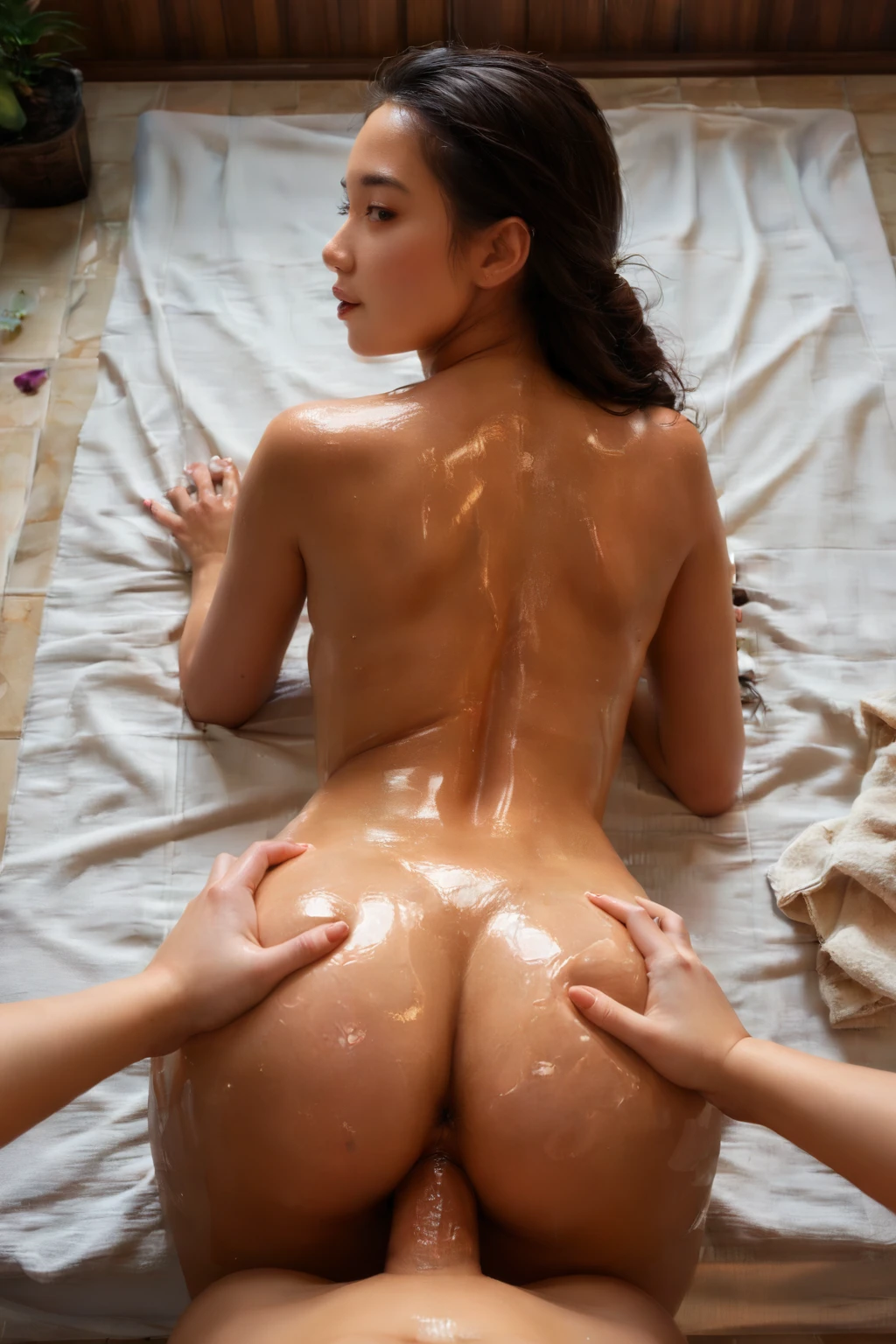

How to Generate Massage AI Images — Complete Guide
A low room, candles doing most of the lighting, a rolled white towel and a bottle of oil sitting at the edge of the table. Warm light hits skin that is already slick, so every highlight pools and runs. Somewhere in that frame, a pair of hands is pressing down. That is the massage category on AINudeGirls, and it is worth understanding because so many images that look like this one are not actually massage at all.
For background on the subject itself, see Massage on Wikipedia.
Pick massage in the generator and the scene assembles itself. The category page shows you what comes out before you spend anything.
Reading a Massage Image
Massage here means one thing: an erotic massage in progress, oiled hands on her body. Two elements have to be visible, and they are not negotiable — hands actually making contact in a massaging motion, and oil that reads on camera as a sheen, a pooled highlight, skin that glistens.
That is a narrower definition than the everyday word. A woman on a table in a half-open robe, candles lit, nobody touching her? Spa scene. Bedroom scene. Not this. The category is built around the verb rather than the room: someone has to be doing the massaging. Get those two things in frame and everything else — the table, the towels, the candlelight — is set dressing that can change freely.
massage example 1
massage example 2
massage example 3
massage example 4
massage example 5
massage example 6
massage example 7
massage example 8
massage example 9
massage example 10
massage example 11
massage example 12
massage example 13
massage example 14
massage example 15
massage example 16
Thirty of these sit in the massage gallery. If you only want the photoreal end of the range, there is a realistic cut of the same category.
How to Set It Up
Open the Generate page, pick massage — one category or several — and start the generation. Results land in your gallery as WebP at 1312x1968, portrait, which is the shape a body on a table wants anyway.
A single image costs 15 credits. Sets are cheaper per picture: five for 68, ten for 120, which is the sensible way to buy yourself variations of the same setup rather than betting everything on one roll.
Two things worth doing on the way in. If you want the same woman across a run of images, pick the same AI model — that gives the generation a fixed face instead of a fresh one every time. And if you want a man in the frame, that only happens when you switch the male-partner control on; left alone, massage scenes are between two women.
Prompt Anatomy
You never type any of this. Picking the category is the whole interaction. But it is useful to see what the category actually contributes, because it explains why the images come out the way they do.
In long form, massage composes as a full scene description:
```text
two completely nude young women in a spa room, one lying face-down on a professional massage table with her bare back, ass and legs glistening with warm oil, the other girl standing beside the table as masseuse with her oiled hands kneading deep into the lower back and ass cheeks, rolled white towels and oil bottles beside the table, soft candlelight spa ambience, two women in frame, women only, no men
```
Read it in three parts. The people and the pose come first — two women, one face-down on the table, one standing over her. Then the physical evidence of the massage: oiled skin, oiled hands, kneading into the lower back and ass. Then the room, the towels, the bottles, the candlelight. Front-loading works exactly the way it does when you describe a photo to a friend: subject, then action, then setting.
There is a compact tag version of the same scene as well:
```text
(2girls, massage:1.3), yuri, one girl lying face-down on massage table, oiled skin, the other girl massaging her back and ass, oiled hands, towels, candles, spa room, completely nude, women only
```
Note the weight on `massage:1.3`. The action gets pushed harder than everything around it, because the action is the thing that has to survive.
When massage is layered onto another category rather than driving the scene itself, it shrinks to a single clause:
```text
on a massage table with warm oil glistening on her body, soft candlelight
```
That is massage's whole contribution in combination form — the table, the oil, the light. Whatever category you pair it with supplies the pose and the act. Three nouns anchor all of it: massage, massage oil, massage table.
Not to Be Mistaken For
Massage sits close to several categories people reach for by accident. Here is where the lines are:
Category What it actually is
--- ---
massage (this guide) an erotic massage in progress, oiled hands on her body
lesbian two (or more) women being sexually intimate with each other, no man present
spanking a hand striking her bare buttocks, ass reddened from the impact
anal penetration of her anus, cock in her ass, cheeks spread
Building a Bigger Scene
Massage is a setting, so it takes one setting at a time. Pick massage plus another scene — a bathroom, a balcony, a bedroom — and only one of them will show up in the image; the other quietly loses. That is not a bug to work around, just something to know before you wonder where your beach went.
Poses and expressions are a different matter, and they stack fine. Pair massage with 69-position, against-wall or ahegao and you keep the oil and the table while the body does something else entirely.
The variations that cost you nothing are the ones inside the frame. Framing is the big lever: tight on hands sinking into skin reads voyeuristic and close, a wide shot of the whole table shows both women and the room they are in. Lighting changes the oil more than anything else does — candles and low lamps make the sheen glow and slow the whole scene down, while cooler directional light hardens the highlights and gives it a clinical edge. Wardrobe shifts tone without touching the action: a half-removed bathrobe, lingerie left partly on, plain sleepwear. Props sell it. An oil bottle in shot, a towel over the table edge, a folded robe nearby.
Change all of it if you like. Just not the hands and the oil.
Where Massage Generations Go Wrong
The most common failure is not technical at all — it is treating the word as shorthand for relaxation. No hands on her, no visible oil, and you have generated a spa photograph. The massage table sitting right there in frame does not rescue it.
The technical failures cluster around the point of contact, which is the hardest thing in the image. Two bodies can merge where they touch. Hands duplicate, or a third one appears. Hands come out malformed, which is a known weak spot for image generation generally and gets worse in a close two-person pose. An unwanted man occasionally wanders into a scene that is supposed to be two women.
None of these are worth debugging. Regenerate. A fresh roll on the same category pick clears it up far more often than not, and generating a set rather than a single image means you have alternatives already sitting in the gallery.
Things Worth Knowing
My image has a massage table and candles but nobody is touching her. What went wrong?
Nothing broke — you got a spa scene instead of a massage one. Hands in contact and visible oil are the two things that make the category what it is. Regenerate and check for both.
Can I control the mood, or is it always candlelit and slow?
Setting, lighting, wardrobe, framing and mood are all adjustable, and swapping warm light for cooler directional light genuinely changes how the image reads. The one thing that has to survive every variation is oiled hands on her body.
How do I keep the same woman across several images?
Pick the same AI model. It gives the generation a consistent face rather than starting cold on each run.
What do I actually get back?
WebP files at 1312x1968, delivered to your gallery. A single image is 15 credits; five cost 68 and ten cost 120.
Where to Go Next
The neighbouring categories, if massage is not quite the thing you were after:
Every category guide is listed on the blog index.