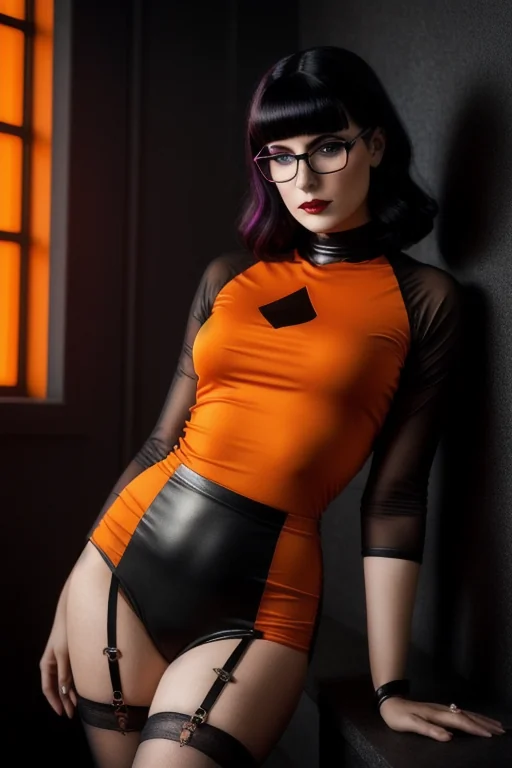

How to Generate Glasses AI Images — Complete Guide
Frames are a small piece of wardrobe that carry an unreasonable amount of a portrait. Acetate or thin metal, sitting on the one part of the body a viewer looks at first — eyewear changes how a face reads before anything else in the shot registers. That is the entire job of the glasses category on AINudeGirls. You pick it, and the platform writes the wording that goes with it. Nothing to type, nothing to tune.
For background on the subject itself, see Glasses on Wikipedia.
Everything here applies both on the glasses category page and inside the generator.
Reading a Glasses Image
The category's definition is four words long: stylish glasses, librarian aesthetic. Glasses have to be visible and unmistakable in the frame — that is the one thing the category requires.
Note what it does not require. No books. No stacks, no reading lamp, no set dressing at all. "Librarian" here is a register, not a location: it points at something composed, studious, slightly buttoned-up, and it lands entirely on the face. The eyewear stays the subject.
glasses example 1
glasses example 2
glasses example 3
glasses example 4
glasses example 5
glasses example 6
glasses example 7
glasses example 8
glasses example 9
glasses example 10
glasses example 11
glasses example 12
glasses example 13
glasses example 14
glasses example 15
glasses example 16
Sixteen of the thirty published frames are above; the rest sit in the full glasses set, and the photoreal cut narrows the same category to its realistic renders.
Running a Glasses Generation
Open the Generate page, pick glasses (on its own or alongside other categories), and start the run. Results land in your gallery as WebP at 1312x1968.
One image costs 15 credits. A set of five is 68 and a set of ten is 120, so batching is cheaper per frame than repeated single runs — useful here, because eyewear is the kind of detail worth choosing between. Video runs cost 250.
Scenes are built around one woman by default; a male figure only appears if you switch on the male-partner toggle.
Where Glasses Generations Go Wrong
Two expectations cause most of the disappointment.
The first is scenery. People pick this category imagining shelves, a desk, a warm reading light — and get a portrait instead. That defining look is carried by the eyewear alone, so if you want an environment, the environment has to come from a category that supplies one.
The second is company. Nothing in a glasses run puts a second person in frame on its own; it is a solo category unless you change that yourself.
And one that is easy to fix: a shot where the frames are barely legible isn't really a glasses image. The category exists to make eyewear unambiguous, so favour outputs where you can actually read the shape of the frames.
Prompts and Settings That Work
You never write a prompt on this platform. Categories are the input, and the wording is assembled for you — so the useful thing to know is what glasses contributes to that wording. It is one clause:
Modifier clause:
```text
wearing stylish glasses for an intelligent sexy librarian aesthetic
```
Read it in pieces. "Stylish glasses" names the hardware and keeps it in frame as the subject; spectacles is the same thing under a different word and adds nothing new. "Intelligent" and the nerdy register push the styling toward something studious rather than merely decorative. "Librarian aesthetic" supplies the scholarly tone without dragging a location in with it. Together they describe a fashionable accessory with a point of view — which is why the outputs feel refined rather than costume-y.
Because the clause is a description of a person and not a scene, it slots into whatever else you pick. Choose glasses alongside voyeur, for instance, and the scene half reads:
```text
a young woman caught in private intimate moment through a partially-open doorway, unaware of the watching camera, dramatic peeping perspective with soft natural light
```
The framing, the light and the situation come from that pick; the frames on her face come from yours.
As for settings: there is nothing to set. Output is fixed at WebP 1312x1968 on every run, which keeps files small enough to load quickly and tall enough for portrait framing.
Mixing Glasses Into a Scene
The same trick works with explicit scene categories. Pick glasses together with vibrator and the scene side brings all of the action:
```text
a young woman lying back spread-eagle on white sheets with legs wide open and knees bent apart, holding a powerful pink silicone vibrating wand pressed firmly against her completely shaved smooth pink pussy, the vibrator clearly visible and prominent in frame, body trembling and back arched in approaching orgasm, free hand gripping the sheets, intimate low-angle three-quarter view focused on the vibrator against her exposed pussy, soft warm bedroom lighting, female alone in frame, no other people
```
Glasses contributes the one clause and stays out of the way of everything else. That is the practical rule for stacking: let a scene category decide the situation, the angle and the light, and let glasses decide how she looks while it happens. Both of these combinations stay single-person, which matches how the category behaves on its own.
Neighbouring Categories
Worth knowing the difference between the two things you can pick:
- [Realistic glasses](/en/categories/glasses/realistic) is the same category, filtered to photoreal output. Same clause, narrower visual range. Start here if stylised renders aren't what you're after.
- Scene categories such as vibrator and voyeur answer a different question. They set what is happening and where the camera is. Glasses answers only what she is wearing, which is exactly why the two combine cleanly instead of competing.
Glasses Questions
Q: Do I need books or a library set for this to work?
No. The category is defined as stylish glasses with a librarian aesthetic, and the definition stops at the eyewear. A library setting is never required.
Q: Do I have to write the prompt myself?
No. Picking the category is the whole input; the clause above is what your pick adds to the finished wording.
Q: What do I get back, and what does it cost?
A WebP image at 1312x1968. Fifteen credits for a single image, 68 for a set of five, 120 for a set of ten.
Q: Can I see only the photoreal versions?
Yes — the realistic glasses selection shows that cut of the category.
Continue Exploring
Thirty published examples are waiting in the glasses gallery, with the photoreal ones split out here. When you want your own set, the generator is one pick away, and every other category has a guide like this one on the blog.