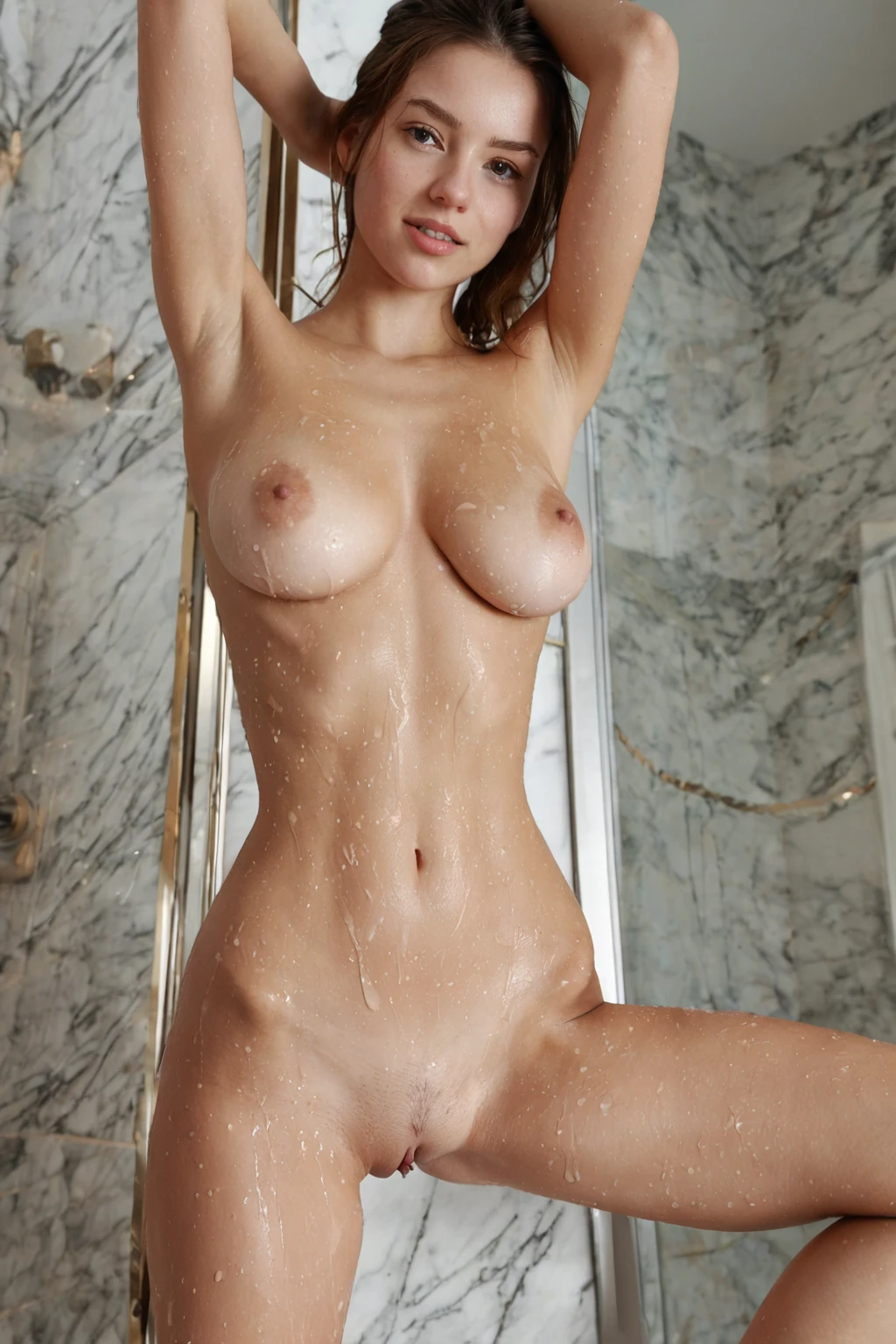

How to Generate Portuguese AI Images — Complete Guide
Warm, sun-bronzed skin rather than olive. Hair with real wave in it — long, dark brown, catching the light along the curl instead of lying flat against the head. Those two things are what the portuguese category nails down for you before you touch anything else. Everything you'd normally burn description on — tone, texture, length — is already handled, which leaves your picks free for wardrobe, setting, framing and mood. Browse the portuguese gallery to see how wide that range runs, then build your own in the generator.
Portuguese, Precisely
The category resolves to one subject: a Portuguese woman with golden-tan skin and dark wavy hair. That is the whole definition, and it is not negotiable — an image that doesn't put a Portuguese woman clearly in frame isn't a result from this category at all, whatever else is going on in the shot.
Write the category name lowercase, as portuguese, when you search or filter for it. The two keywords that carry this identity across the platform are portuguese and portugal. Everything past that — what she's wearing, where she is, how she's lit, what she's doing — comes from your other picks.
portuguese example 1
portuguese example 2
portuguese example 3
portuguese example 4
portuguese example 5
portuguese example 6
portuguese example 7
portuguese example 8
portuguese example 9
portuguese example 10
portuguese example 11
portuguese example 12
portuguese example 13
portuguese example 14
portuguese example 15
portuguese example 16
There are 30 examples in total on the portuguese gallery page. If you'd rather skip the stylised ones and look only at photoreal work, the realistic portuguese view narrows it down.
Prompt Anatomy
You never type any of this yourself. The platform writes the prompt from the categories you tick, and portuguese contributes exactly one clause to that assembly:
```text
beautiful Portuguese woman with warm golden-tan skin and long dark brown wavy hair
```
Read it in three pieces. *Beautiful Portuguese woman* fixes who the subject is. *Warm golden-tan skin* pins the undertone to warm rather than olive — that single word is why this category exists separately from its neighbours. *Long dark brown wavy hair* handles colour, length and texture together, so the wave and the volume come along whether or not you thought to ask for them.
That clause is the entire contribution. The scene arrives from whatever you pick next to it. Choose standing alongside it and the composed result is a POV shot from behind: one leg lifted onto a chair, hands braced on the chair back, a look thrown over the shoulder at the camera, full body in soft three-quarter light. Choose squirting instead and the same subject clause lands in an explicit low-angle bedroom scene on white sheets. Same woman, same skin, same hair. Everything around her, different.
Your First Run
1. Open the Generate page, tick portuguese, then stack on the categories that define the shot — setting, wardrobe, pose, act, style. Start the generation.
2. The full prompt gets assembled from those picks. Nothing about ethnicity, skin or hair needs writing out.
3. Results land in your gallery as WebP files at 1312x1968 — a tall portrait crop that flatters full-body and three-quarter framing and keeps skin and hair detail intact at a size that still loads quickly.
One image costs 15 credits. Sets work out cheaper per frame: five for 68, ten for 120. Worth knowing before your first run, because even a tightly defined category varies a little between runs, and a set gives you something to choose from rather than something to accept.
Failure Modes
Adding words that fight the core identity doesn't override it. Ask for pale skin or poker-straight blonde hair on top of this category and you won't get a different woman — you'll get a muddled version of the same one. The subject is the constant; build around it rather than against it.
Leave your description blank and the platform fills in that defining look on its own. That's a safety net, not a limitation, but it does mean wording that conflicts too directly with the core traits can quietly lose.
The more common miss is a scene mismatch. Pair this category with a setting or style that pulls hard against a warm coastal-European mood and the image can come out feeling wrong even though the subject rendered perfectly well. When results disappoint, look at the other picks first.
Easily Confused With
Four categories in this corner of the catalogue share warm skin and dark hair, and they get swapped for one another constantly. Here's what each one actually resolves to:
Category What it actually is
--- ---
portuguese (this guide) Portuguese woman, golden-tan skin, dark wavy hair
middle eastern Middle Eastern woman, olive skin, dark eyes
arab Arab woman, olive skin, dark features
persian Persian woman, olive skin, dramatic dark eyes
The split is undertone and texture. Golden-tan reads sun-bronzed and warm; the olive base shared by the middle eastern, arab and persian categories reads cooler and greener. Hair pulls the same way — loose wave here against the darker, straighter default those three tend toward. If the look you're after is coastal European rather than Levantine or Persian, this is the accurate pick, and no amount of extra description will make one stand in for another.
Mixing Portuguese Into a Scene
Treat "portugal" as a cultural key rather than a location lock. An Algarve coastline, a Lisbon rooftop at golden hour, a sun-bleached fishing village, a bare studio backdrop — all of them sit fine under this category, because it never claimed the setting in the first place. Your other picks are what build lighting, environment and wardrobe around the subject: golden hour or hard midday sun, beach or bedroom or balcony, swimwear or lingerie or loose summer cotton.
Ethnicity is a one-per-image slot. Tick two and only the first one you selected reaches the image — the second is simply dropped, so the result stays coherent instead of half-blending two faces into something that looks like neither.
She's alone in frame by default, too. A second person only appears if you switch on the male-partner toggle before you generate; it can't be added to an image after the fact.
Quick Answers
Q: Do I have to describe her skin and hair myself?
No. Both are part of the category. Spend your description on the things that change between images instead — pose, wardrobe, setting, light.
Q: Can I make her hair straight, or her skin paler?
Not through description. The subject definition holds across every generation in this category, which is exactly what makes results consistent from one run to the next. If you want a different look, you want a different category.
Q: How do I tell portuguese apart from persian or arab when I'm picking?
By undertone. Portuguese resolves warm and golden; persian and arab both resolve olive, with darker, straighter features. Compare a few results in each gallery and the difference stops being subtle.
Q: Is there a way to see only the photoreal results?
Yes — the realistic portuguese view filters the gallery down to the photoreal selection.
Related Categories
The three nearest neighbours, each with its own guide:
- How to generate middle eastern AI images
- How to generate arab AI images
- How to generate persian AI images
Every category guide is indexed on the blog.