
How to Generate Spanish AI Images — Complete Guide
Fringe swinging off a shawl. Hair so black it goes blue where the light hits it. Olive skin against sun-bleached stone at the end of the afternoon. That is the register the spanish category works in, and it is a register, not a menu of options you assemble yourself.
You select the category. AINudeGirls writes the description around it and hands back the finished frame. Which means the part you actually shape is everything else — the fabric, the light, the place. The spanish gallery shows how wide that range runs, and the generator is where you make your own.
What Spanish Actually Looks Like
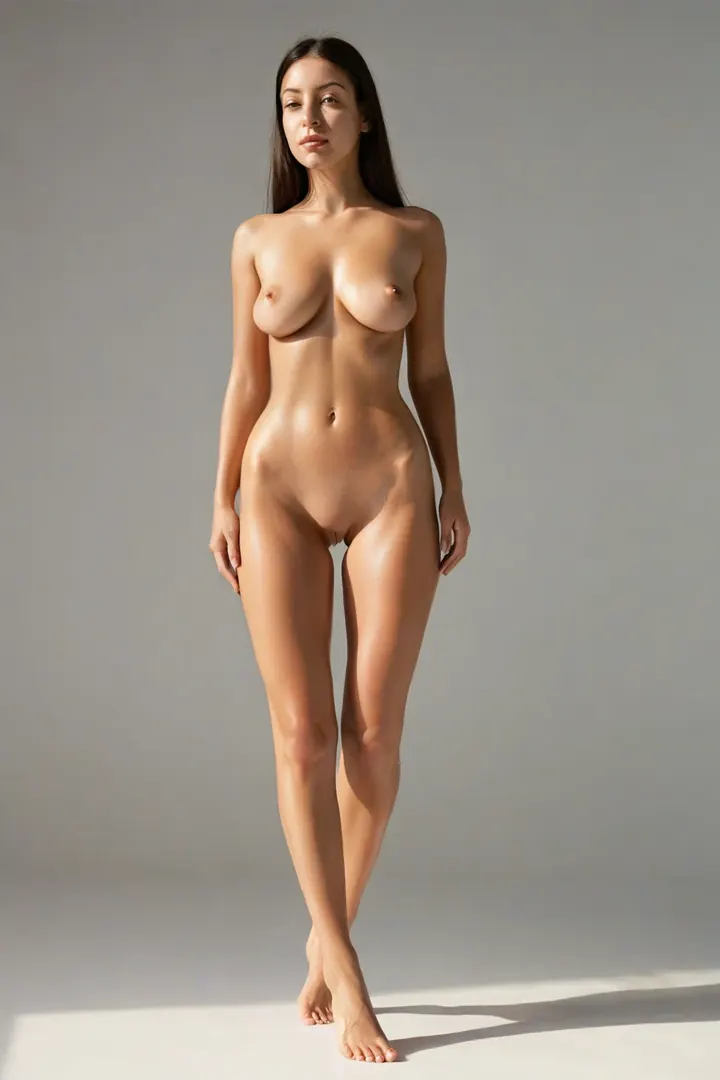
One archetype, tightly held: a Spanish woman with olive skin and jet-black hair. Both, every time.
Olive here means warm and sun-touched — Mediterranean, not porcelain, not deep espresso. Jet-black means jet-black. Not chestnut, not a dark brown that almost gets there, and no highlights running through it. The category doesn't drift into neighbouring nationalities and it doesn't produce male subjects. That fixed pairing is the whole point of picking it instead of typing something vague and hoping.
Everything wrapped around her is yours, and this is where the category repays a little taste. Wardrobe is the fastest lever: a ruffled flamenco dress, a fringed shawl, a polka-dot bata de cola all read as unmistakably Spanish and catch warm light beautifully — the ruffles especially, because they give the frame movement even in a still. Modern streetwear pulls the same face into a completely different century; think Madrid nightlife rather than a folk-costume shoot. Beachwear takes you to the Costa del Sol or Ibiza side of the aesthetic.
Light is the second lever. Golden hour is the reliable one — it is the light Spain is known for, and it warms olive skin without washing it flat. Dramatic shadow suits a Madrid-at-night scene: streetlight, neon spill, hard contrast. Either way, keep the two defining traits legible. Skin blown out to white or hair swallowed by shadow costs you the category.
Setting does atmosphere, never identity. A Seville market stall brings texture and clutter and colour. The Basque coast brings scale and quiet instead. Historic plazas — Plaza Mayor, a sun-bleached Andalusian courtyard — put the image somewhere specific without a single prop having to announce it. A Feria de Abril–style backdrop, all string lights and fans, is the most festive option available, provided the background stays background.
spanish example 1
spanish example 2
spanish example 3
spanish example 4
spanish example 5
spanish example 6
spanish example 7
spanish example 8
spanish example 9
spanish example 10
spanish example 11
spanish example 12
spanish example 13
spanish example 14
spanish example 15
spanish example 16
Thirty examples sit in the full spanish set. If you only want the photoreal end of it, the realistic cut of the category is filtered down to that.
Getting a Spanish Image Out
1. Open the Generate page on AINudeGirls.
2. Pick spanish — on its own, or alongside the scene or act categories you want it composed into.
3. Start the generation. Nothing is typed; the selection is the instruction.
4. The result lands in your gallery as a WebP at 1312x1968 — a tall portrait frame, which is why full-body and three-quarter compositions sit in it so comfortably.
A single image costs 15 credits. Sets are cheaper per shot: five for 68 credits, ten for 120. Since variation between generations is normal and part of the fun, a set is usually the better way to find the one you want rather than firing off singles and comparing them one at a time.
Avoidable Mistakes
Most misses in this category are editorial, not technical.
The commonest is wardrobe and backdrop pulling in opposite directions. Flamenco ruffles in front of a club wall reads as confused rather than eclectic; the dress is saying one decade and the room another. Pick the century first, then dress her for it.
The second is letting the light eat the archetype. Heavy neon contrast is gorgeous until the jet-black hair merges into a dark background and the olive tone goes grey. Give her something to separate against — pale stone, a lit doorway, warm bounce off a wall.
The third is a backdrop that outshouts her. Festival scenes get busy fast. String lights, fans, crowds and colour everywhere will happily take over the frame if you let them, and then you have a picture of a fair with a woman in it.
And the fourth, quietly the most expensive: reaching for this category when you actually wanted a different olive-skinned look. See below.
The Prompt Behind the Picture
You never write this. It is worth seeing anyway, because it explains why the results are so consistent. Each category on the platform contributes one fixed clause to the description, and spanish contributes exactly this:
```text
beautiful Spanish woman with sun-kissed olive skin, long jet-black flamenco hair and fiery dark eyes
```
Read what it's doing. It names the ethnicity outright, then pins the two defining traits with specific adjectives rather than generic ones — "sun-kissed" instead of merely olive, "flamenco hair" instead of merely black — and adds fiery dark eyes to finish the face. Specificity is the difference between landing the look and landing a near-miss, and the platform carries that specificity for you every single time.
The clause describes a person, not a scene. The scene comes from whatever else you select. Pick spanish alongside a scene category such as against-wall, for instance, and that second pick brings the whole staging with it:
```text
POV first-person view of a young woman alone, pressed against a textured wall, her back arched as she looks over her shoulder at the camera, hands flat against the wall above her head, hungry expression, full body visible, bright soft lighting casting soft even light, female alone in frame, no other people
```
Her wall, her pose, her lighting — and your Spanish clause supplying who she is. Pair it with an ahegao bedroom scene instead and the framing changes completely while the archetype holds. That is the whole composition model: one category for the person, one for the situation.
What to Select Alongside
Ethnicity is one per image. Select spanish and a second ethnicity category in the same run and only the first one you picked shows up in the result — the second isn't blended in or layered over it. If you want the Persian look, pick Persian on its own.
Scenes and acts are the opposite: that is what spanish is built to be combined with, and it is where the variety comes from. Shared-frame categories that need more than one person are the exception — those aren't available with this one. The scene stays solo unless you switch on the male-partner toggle before generating.
Spanish Compared
Olive skin is the baseline for several ethnicity categories, which is precisely why they get mixed up. The differences are in the finishing:
Category What it actually is
--- ---
spanish (this guide) Spanish woman, olive skin, jet-black hair
middle eastern Middle Eastern woman, olive skin, dark eyes
arab Arab woman, olive skin, dark features
persian Persian woman, olive skin, dramatic dark eyes
Spanish is the one defined by the hair as much as the skin. Middle Eastern and Persian lean on eye intensity — Persian most dramatically of the three. Arab is drawn more broadly, around dark features as a whole set rather than any single trait. Put crudely: Spanish is Andalusian, the others are Levantine and Gulf, and choosing correctly at the start saves you a regenerate at the end.
Common Questions
Can I get a Spanish result with dark brown hair instead of black? Not from this category. Jet-black hair is half of what defines it, alongside the olive skin tone — the two travel together by design.
What actually comes back, and what does it cost? A WebP image at 1312x1968, straight into your gallery. Fifteen credits for one; 68 for a set of five, 120 for a set of ten.
Is there a way to see only photorealistic Spanish images? Yes — the realistic style page is the photoreal-only slice of the same category.
How do I decide between Spanish and Persian? By the trait you care about most. Spanish is anchored to jet-black hair on olive skin; Persian is anchored to dramatic dark eyes. Both give you the Mediterranean-to-Middle-Eastern skin tone, so let the feature you want foregrounded make the call.
Related Categories
The three categories nearest to this one, each with its own guide:
- Middle Eastern: olive skin, dark eyes
- Arab: olive skin, dark features
- Persian: olive skin, dramatic dark eyes
Everything else is indexed on the blog.