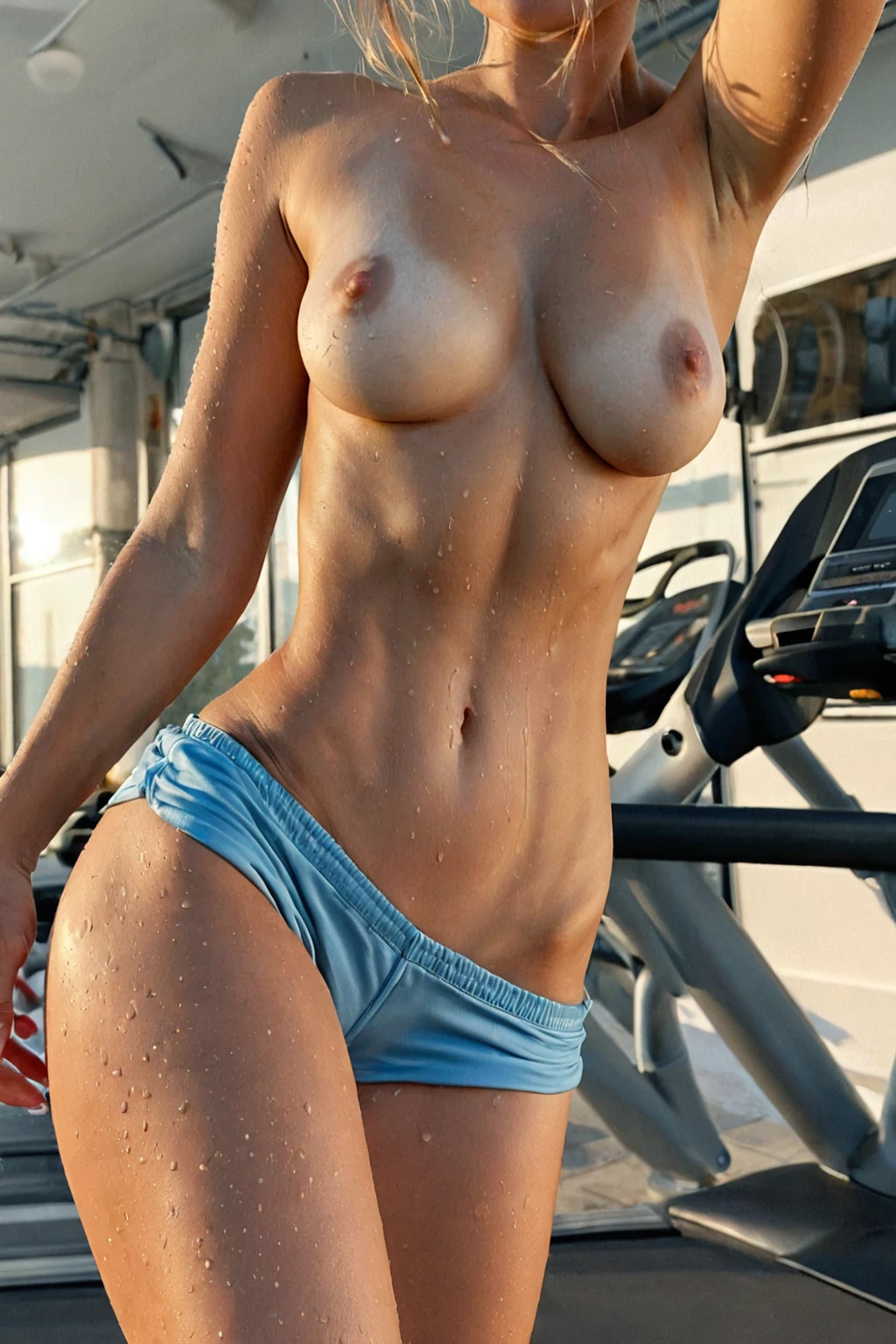

How to Generate Working Out AI Images — Complete Guide
Hard overhead light on a squat rack. A loaded bar, a woman at the bottom of a rep, sweat already tracking down her stomach, head tilted back. Now the other end of the same category: a yoga mat in a sunlit studio, flat morning daylight through the window, a plank held long enough that her hair has stuck to her face. Two rooms, two moods, one idea. On AINudeGirls you get to either of them by picking working out and pressing generate — nothing gets typed.
The generator already has the category wired up, and the working out gallery shows what comes out the other end.
What Makes It Working Out
The category is drawn around a movement in progress, not a look. She has to be caught doing the thing — a squat at depth, a plank being held, a rep mid-contraction — with the physical evidence that goes with it: flexed muscle, sweat, an expression somewhere between focused and strained, and a room that explains the pose. A rack. A mat. Open floor.
That is the whole line, and it is exactly where a generic "fitness" or "sporty" idea falls off it. Activewear is styling. Exertion is activity. A woman standing in a gym looking athletic is a near-miss no matter how good the light is; the platform's category logic is built to pull the result back across that line on its own, which is why you never have to describe any of it.
Making One
Open the Generate page, pick one or more categories, and start the generation. Results land in your gallery, ready to view, download, or run again if a variation doesn't land.
There is no prompt box waiting for you. Selecting the category is the instruction — pose, setting and lighting all get chosen for you from there. Single images cost 15 credits. If you want a spread to choose from, a set of 5 is 68 credits and a set of 10 is 120, which is the honest way to work with a category like this one: not every result nails the exertion cues equally, so generate a handful and keep the two or three where the muscle tension and sweat read hardest.
Everything comes back as WebP at 1312x1968. That tall portrait frame is doing real work here — a deep squat or a full plank needs the whole body in shot, from the line of the shoulders down to the heels, and a wider crop would cut the movement in half.
Failure Modes
The drift to watch for is the one described above: gym clothes standing in for a workout. If you are adding your own free-text description on top of the category, that is where you can accidentally cause it. Words like "sporty" and "toned" describe a body at rest. Words like squat, plank, deadlift, rack, mat and barbell describe something happening, and they keep the image pointed at that defining look instead of drifting back toward a swimsuit shot with equipment nearby.
The other hard part of this category is anatomy. Deep squats and full planks are the poses where limbs, joints and weight-bearing lines are most likely to go wrong, and holding them coherent is the difference between a workout image and an uncomfortable one. That gets handled for you — but it is worth knowing it's the axis this category is fighting on, because it explains why the results stay visibly distinct from plain "athletic" imagery.
The Prompt Behind the Picture
You never write these. The platform assembles them when you pick the category — but seeing one taken apart tells you what the category is actually promising.
```text
a young woman exercising in nothing but tight workout shorts, sweat glistening on her toned muscles and bare breasts, dramatic gym lighting on her flexed body
```
Four jobs in one sentence. *Exercising* fixes the activity rather than the outfit. *Tight workout shorts* keeps the wardrobe plausibly trainable-in. *Sweat glistening on her toned muscles* is the exertion evidence, the part that separates a hit from a near-miss. *Dramatic gym lighting on her flexed body* sets the room and points the light at the muscle that's under load.
The generator rotates through fuller framings of the same idea, so a repeat batch isn't the same photograph with the light nudged:
```text
intimate three-quarter view of a young woman alone in a gym in only tight workout shorts (no top), performing a deep barbell squat at the rack, sweat glistening on her toned muscles and bare breasts, head tilted back with parted lips in exertion, dramatic gym lighting, full body visible, female alone in frame, no other people
```
```text
intimate three-quarter view of a young woman alone on a yoga mat in a sunlit studio holding a perfect plank position completely nude, sweat glistening on her toned bare body, hair plastered to her face, looking down at the mat with focused expression, soft morning daylight, intimate view, full body visible, female alone in frame, no other people
```
Read them side by side and the pattern is obvious. The exertion cues never move. What moves is the exercise, the room, and the light — hard gym overheads in one, soft morning daylight in the other, and the mood swings from public and intense to private and quiet without the category changing at all. The trailing clauses are housekeeping: they hold the camera at a three-quarter angle, keep the full body in frame, and keep her alone in it.
Sixteen results, straight out of the category:
working out example 1
working out example 2
working out example 3
working out example 4
working out example 5
working out example 6
working out example 7
working out example 8
working out example 9
working out example 10
working out example 11
working out example 12
working out example 13
working out example 14
working out example 15
working out example 16
There are 30 in the full working out gallery, and the photoreal-only cut narrows it to the straight-photography look.
Stacking Working Out With Other Picks
Working out is a scene, and one image can only be one scene. Pick it together with something like all-fours or against-wall and only the one you chose first will show up in the result — no blend, no compromise pose. So choose cleanly. That constraint is a feature: a squat and a second scene idea fighting for the same body is how you get a picture that reads as neither.
Partner presence is a separate switch entirely, sitting outside the scene choice. By default she trains alone; flip the male-partner toggle before generating and a partner is added to the frame instead. Because it sits outside the scene slot, you can change it without disturbing which scene is active.
If a particular gym setup keeps landing — the rack, the angle, the light — generate a batch and keep the frames that share it.
Working Out Compared
The categories most often confused with this one, and what actually separates them:
Category What it actually is
--- ---
working out (this guide) she exercises, mid-workout, athletic exertion
all fours on hands and knees, on all fours
bent over standing and bent forward at the hips, ass pushed out toward the viewer or partner
dancing she dances sensually, sinuous movement
Dancing is the closest neighbour and the most instructive contrast: both are movement, but one is sinuous and performed, the other is effortful and functional.
Working Out Questions
Q: My results look like gym photos, not workout photos. What's the difference the category cares about?
Whether the pose could only exist mid-effort. A squat at depth, a held plank, a contraction mid-rep — those qualify. Standing in activewear does not, however good the styling is.
Q: Do I have to describe the exercise myself?
No. Picking the category is the whole instruction; pose, setting and lighting are chosen for you. Free text is optional on top, and if you use it, concrete movement words serve you better than mood words.
Q: What do the finished files look like?
WebP, 1312x1968 — a portrait frame sized so a full standing or floor pose fits without cropping the movement.
Q: What does a batch cost?
15 credits for a single image, 68 for a set of 5, 120 for a set of 10. Sets are the sensible choice here, since the strongest exertion cues tend to show up in two or three frames out of a handful.
Where to Go Next
The neighbouring categories, each with its own guide:
- How to generate all fours AI images
- How to generate bent over AI images
- How to generate dancing AI images
Every category guide is indexed on the blog.