
How to Generate Nun AI Images — Complete Guide
Heavy black wool. A veil pulled close to the head, a collar sitting flat and white against it, fold lines running where the fabric has been gathered and lifted. Every one of those details is doing work, and none of it is decoration. The nun category is built on a garment that exists to cover, photographed at the moment it stops covering.
AINudeGirls writes the prompt for you. You choose the category, set a couple of controls on the Generate page, and the platform assembles the rest — the nun category sits in the generator with everything else on the roster. What follows is what the category actually puts on screen, how to steer it, and the two ways people reliably lose the look.
What Makes It Nun
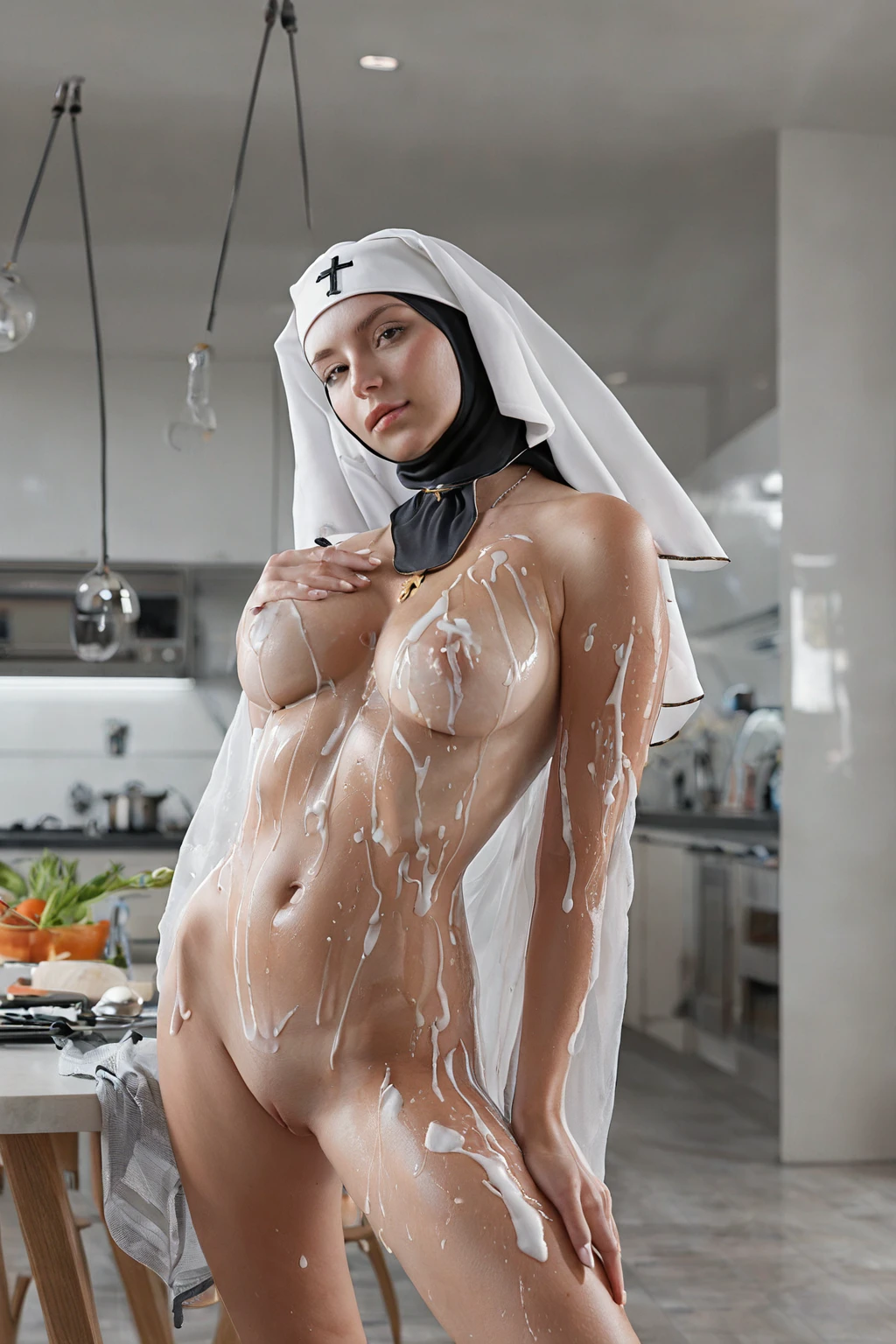
The defining look is narrow and specific: a nun's habit hiked up to reveal the body underneath, carried with a sacrilegious aesthetic. The habit stays in frame. It is disturbed — lifted, pulled aside, displaced — rather than removed.
That distinction is the whole category. A woman in a full, untouched habit is a costume shot. A nude with a black garment somewhere off to the side is just a nude. Nun lives in the gap between them: enough of the habit intact to be unmistakable, enough exposure that the modesty the habit stands for is visibly broken. Strip the wool out of frame and there is nothing left to name the image by.
Material is what sells it. The habit reads as a real garment when the weave has weight — the drape of wool or cotton, the crease where it has been gathered, the matte flatness of black or grey against skin. That contrast in surface, dull fabric against lit skin, is the texture the category runs on.
nun example 1
nun example 2
nun example 3
nun example 4
nun example 5
nun example 6
nun example 7
nun example 8
nun example 9
nun example 10
nun example 11
nun example 12
nun example 13
nun example 14
nun example 15
nun example 16
There are 30 examples in total on the nun gallery, and the photoreal-only cut narrows that set down if you want the straight-photography end of it.
Step by Step
1. Open the Generate page and pick nun. That is the instruction that locks the habit-and-exposure formula in place instead of a generic dark outfit.
2. Add a second category if you want a scene, a pose or a setting around it. The platform composes your picks together — you are choosing ingredients, not typing a prompt.
3. Start the generation. Each image lands in your gallery as a WebP at 1312x1968, ready to view or download.
A single image costs 15 credits. Sets are cheaper per frame: 68 credits for five, 120 for ten. Batching is worth it here, because pose and lighting still vary noticeably from run to run even with the category pinned down.
Working Prompt Examples
You never write these by hand. What nun contributes to a generation is one clause, and this is it:
```text
in nun's habit hiked up revealing her body underneath, sacrilegious aesthetic
```
Read it in three parts. In nun's habit puts the garment in frame and keeps it there. Hiked up revealing her body underneath is the disturbance — the fabric displaced rather than gone. Sacrilegious aesthetic is the mood instruction that pulls framing and lighting toward something transgressive instead of playful.
The clause is only half a picture, though. It says what she is wearing and what has happened to it; it says nothing about where she is or how the shot is framed. That comes from whatever else you pick alongside it. Two combinations that work well:
Pick nun together with selfie-style, and that clause lands inside this scene:
```text
a young woman taking an intimate nude mirror selfie with her phone, exposed body fully visible in the reflection, casual amateur framing with warm bedroom lighting
```
The habit stays, but the register drops to something informal and close — phone in hand, warm indoor light, the disturbed fabric caught in a reflection rather than posed for a camera.
Pick nun together with spanking, and you get this instead:
```text
a young woman alone bent over the edge of a bed with her ass raised, faint pink handprints across her cheeks, looking back over her shoulder with a submissive expression, full body visible, bright soft lighting, female alone in frame, no other people
```
Here the posture does the lifting. Bent forward, the habit falls and gathers where it is raised, which is exactly the kind of body position the category's defining look is built for.
Beyond the pairing, three things move results the most. Tight framing beats wide: put the raised fabric and the exposed skin in the same close crop and the image reads as nun immediately, where a wide shot risks losing the habit as the anchor. Lighting does the emotional work — low warm candlelight, or hard directional light that catches the fold lines and the nap of the wool, gives the material presence that flat light flattens out. And a convent setting grounds it: stone walls, a chapel interior, a corridor, a suggestion of stained glass. You do not need an elaborate environment. A hint of place is enough to make the disturbance feel like a violation of something rather than a wardrobe choice.
Telling Nun Apart
Nun against the three categories it sits nearest to on the roster:
Category What it actually is
--- ---
nun (this guide) nun's habit hiked up revealing her body, sacrilegious aesthetic
lingerie delicate black lace lingerie with garters
cop in a sexy police uniform with cap and belt
nurse in a sexy nurse uniform, white outfit with a red cross
Lingerie is the one people mix up most often, and the difference is which way the garment points. Lace and garters are designed to be seen; the appeal is the piece itself. A habit is designed to prevent being seen, which is why disrupting it carries a charge that lingerie has no equivalent for. Want the straps and the lace as the subject? Lingerie. Want a symbol coming undone? Stay here.
Stacking Nun With Other Picks
Nun belongs to a group of outfit-led categories that cannot share a frame. Pick nun and bikini together and you do not get a blend of the two — one look wins and the other simply does not appear. Bodysuit, bride, bunny-girl and cat-girl behave the same way, and in each of those pairings the nun look is the one that comes through.
Angel is the neighbour worth knowing about. It runs on the same logic — sacred imagery, disrupted — so if you are exploring outward from nun rather than away from it, that is the adjacent pick most likely to hold the tone.
Scene, pose and setting categories are a different matter entirely. Those stack cleanly, which is what the selfie-style and spanking pairings above are doing.
Scenes here come out solo. A partner can be switched on from the Generate page if you want one, but nothing past a one-on-one setup is available for this category, so plan around solo or two figures.
Getting It Wrong
Dropping the habit is the first failure, and the most common by a distance. A sliver of black fabric at the edge of frame is not enough. If the veil, the collar and the weave are not clearly identifiable, the image is a nude that happens to have a dark cloth in it. The garment is a requirement.
The second is the opposite error: a habit that is present, complete and entirely undisturbed. Fully covered, nothing lifted, nothing revealed. Technically a nun, visually inert — there is no tension between garment and body, and tension is the product. Both halves have to be in the same frame at once, with the mood carried through in how it is lit and cropped. Lose either one and the result reads as costume, not category.
A third, quieter miss: leaning on vague descriptors instead of the category itself. Generic terms pull results toward plain costume territory and dilute the specific contrast. Nun, habit and convent are the vocabulary that keeps the category locked in — and rotating which one leads shifts the framing without drifting out of it.
Quick Answers
Q: What actually has to be in frame for an image to count as nun?
The habit, clearly identifiable — fabric, veil, collar — and clearly disturbed enough that the body underneath is exposed. Both, together, in one shot.
Q: Can I combine nun with another outfit category?
Not usefully. Pick two outfits and only one of them shows up in the image; nun is the one that comes through. Scene, pose and setting categories combine with it without any trouble.
Q: What is the difference between the nun category and its realistic style?
Same category, narrower selection. The realistic style page shows only the photoreal end of the set rather than the full range.
Q: What file do I get back?
A WebP at 1312x1968, saved straight to your gallery.
The closest neighbouring categories, each with its own guide:
Every category guide is listed on the blog index.